
What I do is simple. I own a small number of the finest businesses in the world, I try not to overpay for them, and then I wait. People who hear that usually assume the hard part is finding the businesses. It isn’t. The hard part is the waiting.
There is a line widely attributed to Charlie Munger: “The big money is not in the buying and the selling, but in the waiting.” Paul Samuelson made the same point another way, saying investing should be like watching paint dry or watching grass grow — in other words, delayed gratification.
That is harder than it sounds, because almost everything around us now is built for the opposite: instant gratification. The next video, the next delivery, the next price on a screen that changes every second. Compounding works on a different clock. It does its work quietly, in the background, over years, and it pays only those who leave it alone.
Consider Church & Dwight, one of the businesses in my investing universe. You may not know the name, but you will know what it makes: Arm & Hammer baking soda, laundry detergent, toothpaste, cat litter. Think of it as a smaller Procter & Gamble. Nobody talks about it at dinner. Nobody has ever made a film about it. It is about as boring as a business gets.
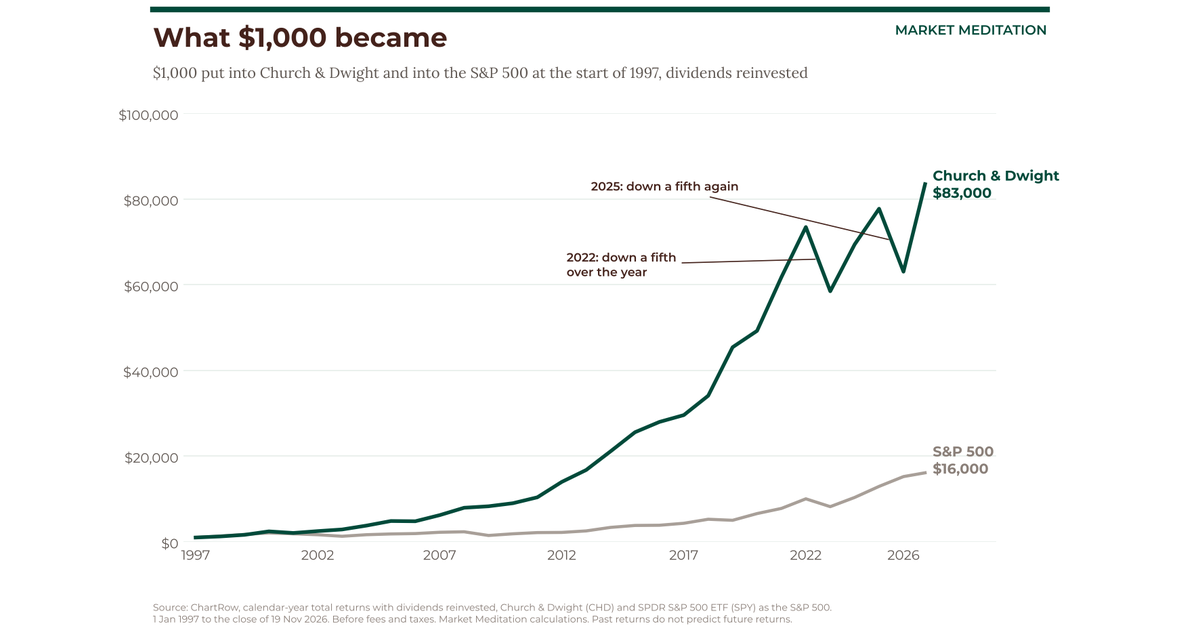
It is also one of the great compounders. Over thirty years, with dividends reinvested, it has returned about 16% a year. $1,000 put into Church & Dwight at the start of 1997 is worth about $83,000 today. The same $1,000 in the S&P 500 is worth about $16,000.

The green line is Church & Dwight, the grey line the S&P 500. For years the gap looks small. Then it becomes enormous. That is what compounding looks like.
None of that came from anything exciting. It came from selling the same everyday things to the same households, year after year, and turning a steady share of every sale into cash.
But it was never a smooth ride, and it did not always beat the market. Over the past year it returned about 34.5%, against about 9.2% for the S&P 500. Over the past ten years it did worse: about 11.1% a year against 14.2%, so $1,000 became about $2,820 while the same money in the market became about $3,720. Over thirty years it was not close.

The same business, measured over three different stretches of time. Ahead, behind, then far ahead. Which picture you see depends on how long you are willing to wait.
Look at the middle of those three. For the better part of a decade, the owner of a fine business watched the market do better. Along the way the shares lost a fifth of their value in 2022, and did it again in 2025. At each of those points there was a more exciting story somewhere else, and a good reason to sell and move on. The owner who did well was the one who did nothing at all — or, better still, added to the position when the shares fell, and was rewarded for it.
That is the part nobody tells you. The work is in finding the business and paying a fair price. After that, the hardest thing is to sit still, to be bored, and to let the machine run.
Simple. But not easy.
Imran Siddiqui
Portfolio Manager
If you missed them: The Most Patient Capital in the World and A temporary dislocation, or a permanent impairment?
This is my personal investing journal, written for information only. It is not investment advice, and nothing in it, including any company mentioned, is a recommendation to buy or sell any security. It does not take account of your circumstances. I may or may not hold shares in the companies mentioned. Past returns are no guide to future returns.
Leave a Reply